










Tariffs

Is the US de minimis exemption still available in 2026?
No. Duty-free de minimis treatment ended for all countries on 29 August 2025 under Executive Order 14324, and US Customs and Border Protection made the suspension indefinite across all modes of transport in interim final rules published on 24 June 2026. Postal shipments lost their remaining carve-out on 24 July 2026. Statutory repeal follows on 1 July 2027.
What this means in practice: every DTC parcel entering the US now requires a customs entry with duty owed, whatever its value and whichever way it travels. There is no low-value threshold left to ship under, and no reinstatement to wait for.
Longstanding personal exemptions are unaffected: US travellers can still bring back up to $200 in personal items, and individuals can still receive bona fide gifts valued at $100 or less duty-free.

What is de minimis, and what was the $800 threshold?
De minimis was a US customs provision under 19 U.S.C. 1321(a)(2)(C), commonly called Section 321, that let shipments valued at $800 or less per person per day enter the United States free of duty and tax. It was suspended in August 2025 and no longer applies to commercial ecommerce shipments.
What changed for EU shipments on 1 July 2026?
The EU removed its €150 duty-free threshold. Every order shipped to an EU consumer from outside the EU now requires a full customs declaration, and orders of €150 or less carry a flat duty per product category (HS code) per declaration line. Orders above €150 continue under standard duty rules, unchanged.
The charge applies per product category, not per item. Ten units of the same product on one order attract a single charge; an order spanning ten different product categories attracts ten. Brands with broad catalogues and multi-category baskets are therefore more exposed than brands shipping a single product type per order.
Coming 1 November 2026: an additional EU handling fee per declaration line, and product identifiers become mandatory at variant level — your own product code, the manufacturer's reference, and a standardised barcode such as a GTIN, EAN or UPC where one exists. Declarations missing these risk being held or rejected at the border. Swap applies the EU duty automatically at checkout; no configuration or activation is required.
What are the Section 301 tariffs introduced in July 2026?
On 24 July 2026 the United States introduced tariffs under Section 301 of the Trade Act of 1974 covering 60 economies — 59 countries plus the EU as a bloc — which together account for roughly 99.4% of US imports by value. Rates vary by economy, and for several advanced economies the duty is calculated net of the existing rate on that specific product, so the real impact depends on the product's classification.
Duty follows where goods are made, not where they ship from. A product manufactured in China and dispatched from a UK warehouse is still Chinese-origin for customs purposes and pays the China-tier rate. Because there is no longer a de minimis threshold, there is no low-value route around this.
Because the exact rate turns on product classification and country of origin, Swap calculates it per order at checkout rather than applying a blanket uplift. Talk to us if you want your specific catalogue and sourcing lanes reviewed.
How does Swap keep cross-border orders compliant?
Swap calculates duties and taxes at the point of checkout and keeps those calculations current as rules change, so shoppers see a final price and your margins stay predictable.
- Total landed cost calculated at checkout against current rules, including US duty on all low-value shipments and the EU flat duty on orders under €150
- Tax compliance managed so your business stays in good standing with the relevant authorities, including US Customs and Border Protection
- Shoppers keep receiving orders DDP, with duties, taxes and fees paid at checkout — avoiding customs delays and charges at the door
- Rule changes tracked and applied for you, so you are not rebuilding duty logic every time a new order or regulation lands

Take on tariffs.
Take back profit.
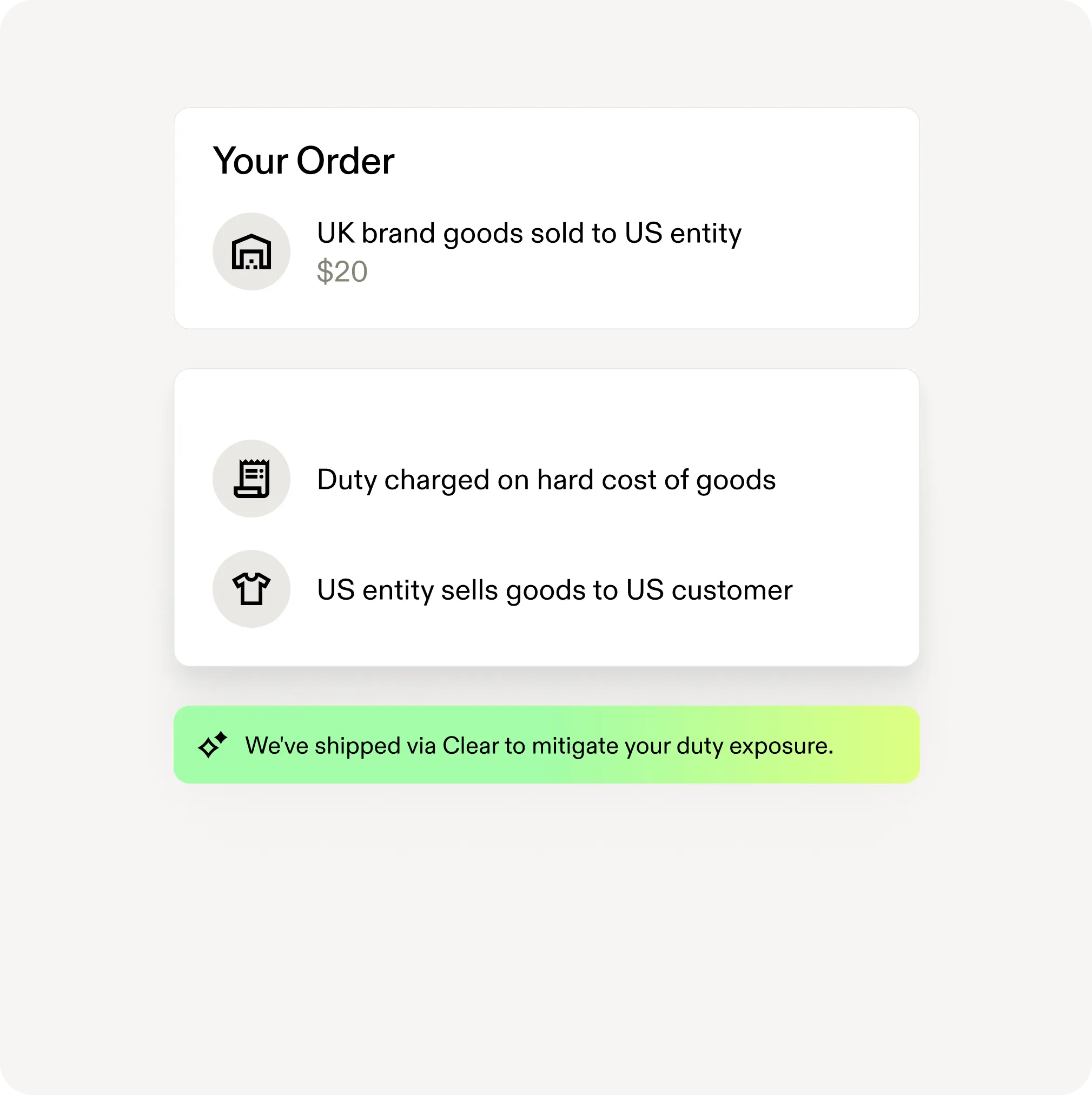
Clear by Swap lets brands import into the US through a business-to-business sale to their own US entity, so duty is assessed on wholesale transfer value rather than full retail price — and enables duty recovery on returns. Cross-border compliance that reduces your exposure to tariffs. Commerce, clarified.
1,000+ brands count on Swap













Book a free, 15-minute demo with a specialist
See your operations streamlined by the power of Swap.